MP Deep Neck Lift and SubSMAS Facial Rejuvenation Volume 4 – Mike Nayak 2026This item
$129.99
Total for 4 items: $412.97
Download links arrive by email within minutes and stay in your account library.
Advanced Facial Rejuvenation Surgical Video Series
L. Mike Nayak, MD
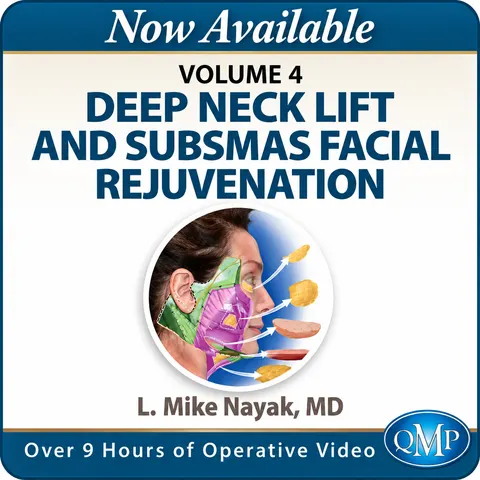
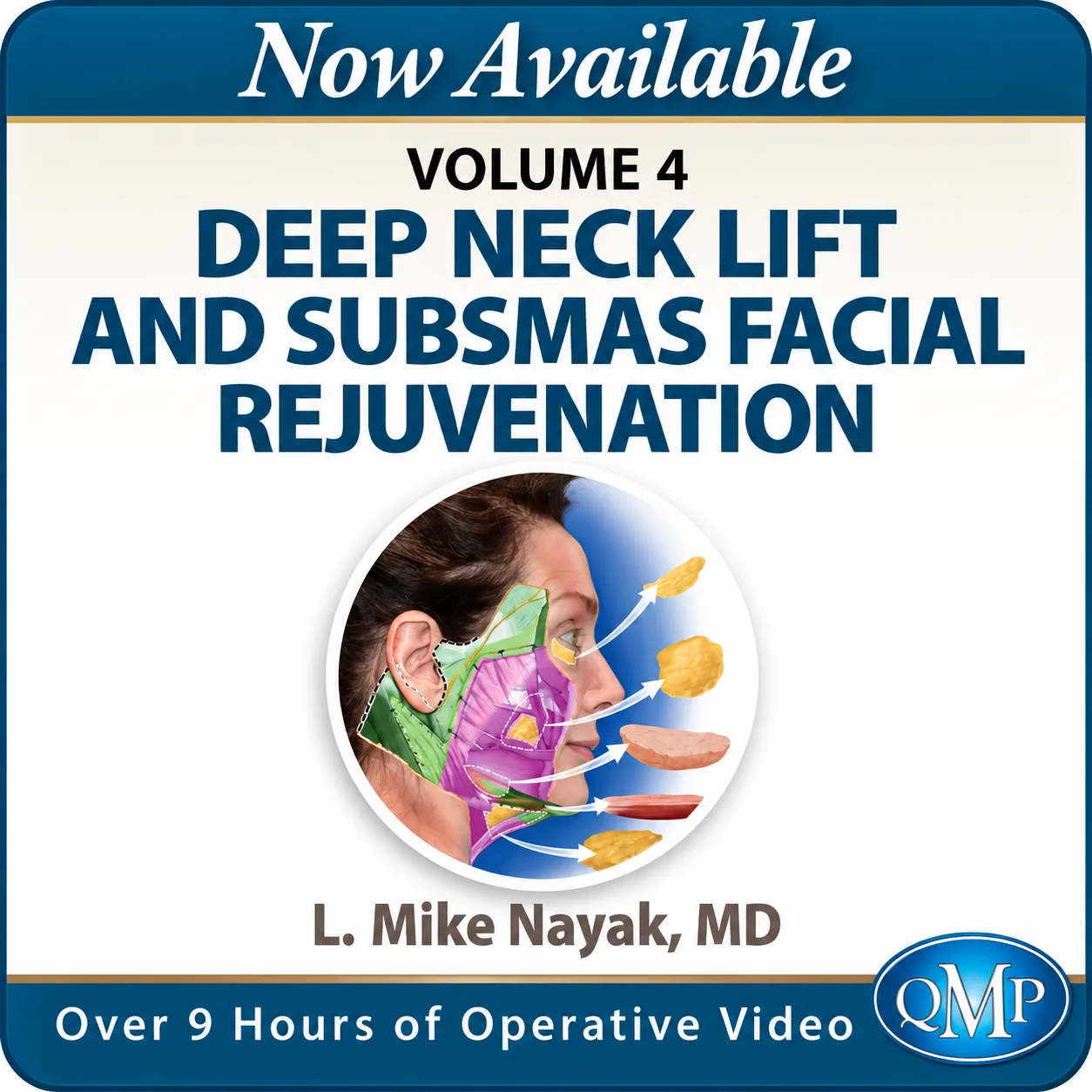
QMP Deep Neck Lift and SubSMAS Facial Rejuvenation Volume 4 is the newest installment in L. Mike Nayak, MD’s advanced facial rejuvenation surgical video series.
Volume 4 continues the evolution of Dr. Nayak’s approach to:
The program contains four complete operative cases with more than nine hours of surgical video, including detailed demonstrations of advanced face and neck rejuvenation in patients with substantial facial laxity and major tissue changes after significant weight loss.
This volume builds upon concepts introduced in earlier installments while adding refinements in:
The central surgical concept is:
Analyze the Aging Pattern → Plan the Deep Structural Correction → Mobilize With Tissue Preservation in Mind → Reposition the Face and Neck → Refine Contour → Integrate Adjunctive Procedures
Facial rejuvenation surgery increasingly involves more than excision and redraping of lax skin.
The operative demonstrations in Volume 4 focus on deeper anatomical structures and on modifying the structural foundations of the aging face and neck.
The course explores relationships among:
Rather than treating every aging face with an identical maneuver, the cases demonstrate individualized planning according to:
The provided digital course collection includes:
One of the main themes of Volume 4 is further refinement of preservation facelift surgery.
The course demonstrates approaches designed to limit unnecessary tissue separation while retaining sufficient mobility for effective facial repositioning.
Important concepts include:
The objective is not merely to tighten skin.
Instead, the operative strategy addresses deeper support and facial architecture.
A preservation-oriented facelift attempts to maintain selected tissue relationships while repositioning deeper facial structures.
This differs conceptually from approaches based primarily on:
Volume 4 focuses on controlling the deeper tissues while reducing unnecessary tissue separation where possible.
The cases incorporate preservation deep plane facelift principles.
Deep plane surgery involves working beneath portions of the SMAS and related structures to permit movement of composite facial tissues.
Important educational areas include:
Because these procedures are anatomically complex, operative visualization is particularly important.
SubSMAS techniques work beneath the superficial musculoaponeurotic system.
The course examines how deep structural modification may contribute to:
SubSMAS surgery requires detailed understanding of facial anatomy and facial nerve relationships.
Deep neck rejuvenation is another major component of the series.
The operative footage provides detailed visualization of deeper areas of the neck that can be difficult to appreciate through conventional external recordings.
The course emphasizes:
The purpose is to understand how neck contour relates to the broader facial rejuvenation plan rather than treating the neck as an isolated structure.
A notable educational feature of Volume 4 is the use of first-person headcam footage.
This perspective is combined with conventional operative cameras to improve visualization of:
For complex deep-plane and deep-neck procedures, the surgeon’s visual perspective can provide educational context that is difficult to reproduce with external camera positioning alone.
The volume introduces updated preservation facelift strategies intended to further reduce unnecessary delamination.
The demonstrations include patients with:
This makes Volume 4 particularly relevant to surgeons studying how preservation concepts can be modified for more challenging anatomy rather than only relatively straightforward cases.
Dr. Nayak demonstrates a structured approach to determining appropriate inset vectors for:
Vector planning affects the direction in which mobilized tissues are repositioned and stabilized.
Important concepts include:
The educational goal is to understand how vector selection relates to the patient’s specific anatomy rather than applying one universal direction of pull.
Volume 4 also emphasizes deep structural facial reshaping.
Techniques demonstrated include:
These techniques extend the rejuvenation concept beyond superficial tissue redraping.
The course demonstrates parotidomasseteric fascia plication as part of the instructor’s structural facial reshaping strategy.
Its role should be understood in relation to:
It is one component of a broader operative plan rather than a stand-alone facelift technique.
The demonstrations also include zygomaticus major tensioning.
This is presented within the instructor’s strategy for modifying deeper facial support and midfacial contour.
Because manipulation in this region occurs near important neurovascular anatomy, the technique is intended for surgeons with appropriate anatomical and operative training.
Malar fat plication is used within selected cases to influence:
Volume 4 integrates this with other deep structural maneuvers rather than treating fat repositioning as an isolated procedure.
The operative series also demonstrates ultrasonic dermal heating during facial rejuvenation surgery.
Within the course, it is used as an adjunct in the surgical workflow, including for:
MedicalAmboss should describe this as:
“ultrasonic dermal heating as demonstrated by Dr. Nayak within the operative workflow.”
Avoid presenting it as universally required for facelift surgery or as guaranteeing improved results.
The first case demonstrates extensive facial rejuvenation in a patient with marked laxity and photoaging.
Procedures include:
This case demonstrates how multiple rejuvenation procedures can be coordinated into a comprehensive surgical plan.
Important considerations include:
This highlights an important principle:
Comprehensive facial rejuvenation requires diagnosis of multiple aging layers rather than treating only skin laxity.
The second case focuses on facial rejuvenation after major weight loss.
Procedures include:
Major weight loss can produce a distinct facial-aging pattern involving:
This case demonstrates how the operative plan is adapted to those changes.
Case 2 includes application of a hemostatic net in response to significant bleeding.
This provides additional educational exposure to intraoperative hemostasis and complication-management concepts.
The technique should be viewed within the context of experienced surgical judgment rather than as a universal requirement in facelift procedures.
Patients after significant weight loss may present differently from patients with primarily age-related laxity.
Potential issues include:
Volume 4 contains two such cases, making massive-weight-loss facial rejuvenation an important secondary theme of the series.
The third complete case demonstrates another comprehensive treatment strategy following substantial weight reduction.
Procedures include:
This case integrates:
Facelift + Neck Lift + Periocular Surgery + Volume Restoration + Surface Treatment
into a single individualized rejuvenation strategy.
Canthopexy is demonstrated as part of the periocular component of Case 3.
Its role is considered within:
The procedure requires specific oculoplastic and facial surgical knowledge.
Earlobe reduction is included as a complementary aesthetic procedure.
Although comparatively limited in scope, it demonstrates the comprehensive approach used in this case to address multiple signs of facial aging.
Lip filler is integrated as an adjunctive treatment in Case 3.
The inclusion illustrates how surgical and nonsurgical modalities may be combined when appropriate within a larger facial-rejuvenation plan.
The fourth case is a bonus operative demonstration originally associated with a live surgical congress in St. Louis.
Procedures include:
This additional case provides another opportunity to observe Dr. Nayak’s operative sequencing and decision-making in a complete facial rejuvenation procedure.
Brow rejuvenation appears repeatedly throughout the cases.
The surgical plan should consider:
Brow surgery is therefore integrated with rather than isolated from overall facial rejuvenation.
Upper and/or lower blepharoplasty appears in several cases.
The demonstrations help illustrate how eyelid rejuvenation can be coordinated with facelift surgery.
Relevant considerations include:
Fat transfer is used throughout the surgical cases to address selected areas of volume loss.
Facial aging can involve both:
Tissue Descent
and:
Volume Change
A comprehensive rejuvenation plan may therefore combine repositioning with volumetric restoration.
Buccal fat reduction is demonstrated in selected patients as part of facial contour refinement.
It should not be interpreted as appropriate for all facelift patients.
Patient selection is particularly important because excessive reduction may contribute to unwanted long-term hollowing.
Full-face laser resurfacing is incorporated into several cases to address surface-level skin aging.
This demonstrates the distinction between:
which addresses deeper structural aging
and:
which addresses selected surface and texture concerns.
Combining procedures requires careful patient selection and perioperative management.
Volume 4 can be viewed as addressing multiple anatomical layers:
This multilayer framework is one of the strongest ways to position the course educationally.
The strongest audience includes:
This is advanced operative education.
It should not be positioned as an introductory facelift course for clinicians without formal surgical training.
Volume 4 represents a further evolution of Dr. Nayak’s aging-face surgery series.
The preceding QMP series established concepts involving:
Adds or further develops:
This helps position Volume 4 as an advanced continuation, not a replacement for basic facial surgical training.
The earlier three-volume QMP series contains:
and progresses from foundational deep neck and facelift surgery toward more advanced SubSMAS and preservation approaches.
Volume 4 expands the collection with:
For users who study the complete sequence, the progression can be conceptualized as:
Volume 1 — Foundations
↓
Volume 2 — Advanced SubSMAS Surgery
↓
Volume 3 — Preservation Facelift Evolution
↓
Volume 4 — Advanced Preservation & Structural Reshaping Refinements
Deep plane facelift, SubSMAS dissection, deep neck surgery, blepharoplasty, canthopexy, fat transfer, laser resurfacing, and related procedures are advanced surgical interventions.
Recorded operative education can support understanding of:
but does not replace:
Avoid marketing claims such as:
Better wording includes:
Clinical outcomes depend on multiple factors including:
The provided course package includes:
If MedicalAmboss supplies this collection through Google Drive without QMP CME or certificate, that delivery information should be stated separately from the original QMP streaming product.
QMP Deep Neck Lift and SubSMAS Facial Rejuvenation Volume 4 – L. Mike Nayak, MD (2026) is an advanced facial plastic surgery video program featuring 4 complete surgical cases and more than 9 hours of operative footage.
Volume 4 introduces further refinements in preservation facelift dissection, deep neck lift, preservation deep plane facelift, SubSMAS facial reshaping, inset-vector planning, parotidomasseteric fascia plication, zygomaticus major tensioning, malar fat plication, ultrasonic dermal heating, and comprehensive facial rejuvenation after major weight loss.
The collection also demonstrates brow lift, blepharoplasty, canthopexy, facial fat transfer, buccal fat reduction, full-face laser resurfacing, hemostatic techniques, and advanced facial contour planning.
Educational notice: Advanced operative education does not replace accredited surgical training, supervised operative experience, credentialing, patient-specific assessment, or complication-management competency.
Customers who viewed this also considered these.
Surgical Courses
5.0Rated 5.0 out of 5Surgical Courses
Surgical Courses
4.9Rated 4.9 out of 5